

The Science Behind the Art
The Accident That Changed Everything
A French philosopher asks why the greatest scientific discoveries were never planned. The answer is on your wall.
Before a single brushstroke goes on a wall, a mural artist opens an app. They sketch the composition on a tablet, adjust the palette using colour-theory tools built on mathematics, and calculate the proportions using geometry. The paint that survives Manchester rain was engineered in a laboratory. The image you walk past every morning on Copson Street is the end product of a chain of science decisions, most of them invisible. This is what science actually looks like. Not a whiteboard. Not a laboratory. A wall in Withington.
Marc Halévy's 14 Grands Génies entre Science et Spiritualité — published in French, not yet translated into English — makes a deceptively simple argument: the greatest scientific discoveries in history were not planned. They were accidents, mistakes, unexpected moments noticed by a mind that was paying attention.
Fleming was not looking for an antibiotic. He was looking at a contaminated petri dish and had the presence of mind not to throw it away. Becquerel — French, like Halévy — was not trying to discover radioactivity. He left uranium on a photographic plate in a drawer during a cloudy week in Paris in 1896, came back to find it fogged, and asked why. The Curies followed that question for the rest of their lives.
Röntgen noticed a glow on a screen across the room. Goodyear dropped rubber on a hot stove. Hofmann absorbed a compound through his fingertips on a Friday afternoon in Basel and spent the weekend understanding what had happened to him. In every case, the discovery was not the result of a plan. It was the result of a prepared mind meeting an unexpected moment.
Halévy's deeper point is about how we teach science — and how we should. The curriculum presents science as a series of correct answers arrived at by correct methods. The history of science tells a different story: a story of wrong turns, contaminated samples, broken equipment, and moments of confusion that turned out to be more valuable than the experiment that was supposed to work.
The quality that connects all fourteen of his geniuses is not intelligence in the conventional sense. It is attention. The willingness to stop, look at the thing that went wrong, and ask: but why?
The discovery was not the result of a plan. It was the result of a prepared mind meeting an unexpected moment.
Withington is surrounded by institutions where this kind of thinking happens every day. At The Christie, researchers run clinical trials whose most important results are sometimes the unexpected ones — the side effect that turns out to be a treatment, the compound that does something nobody predicted. At the University of Manchester, graphene was discovered not in a grand experiment but with a piece of sticky tape and a pencil. André Geim and Konstantin Novoselov were playing. They called it their Friday night experiments — time set aside to try things that probably would not work.
The mural on the wall at Copson Street began the same way. Someone decided to try something. The science that made it possible — the colour algorithms, the UV-resistant pigments, the geometry — was assembled from discoveries that each began with a question nobody had planned to ask.
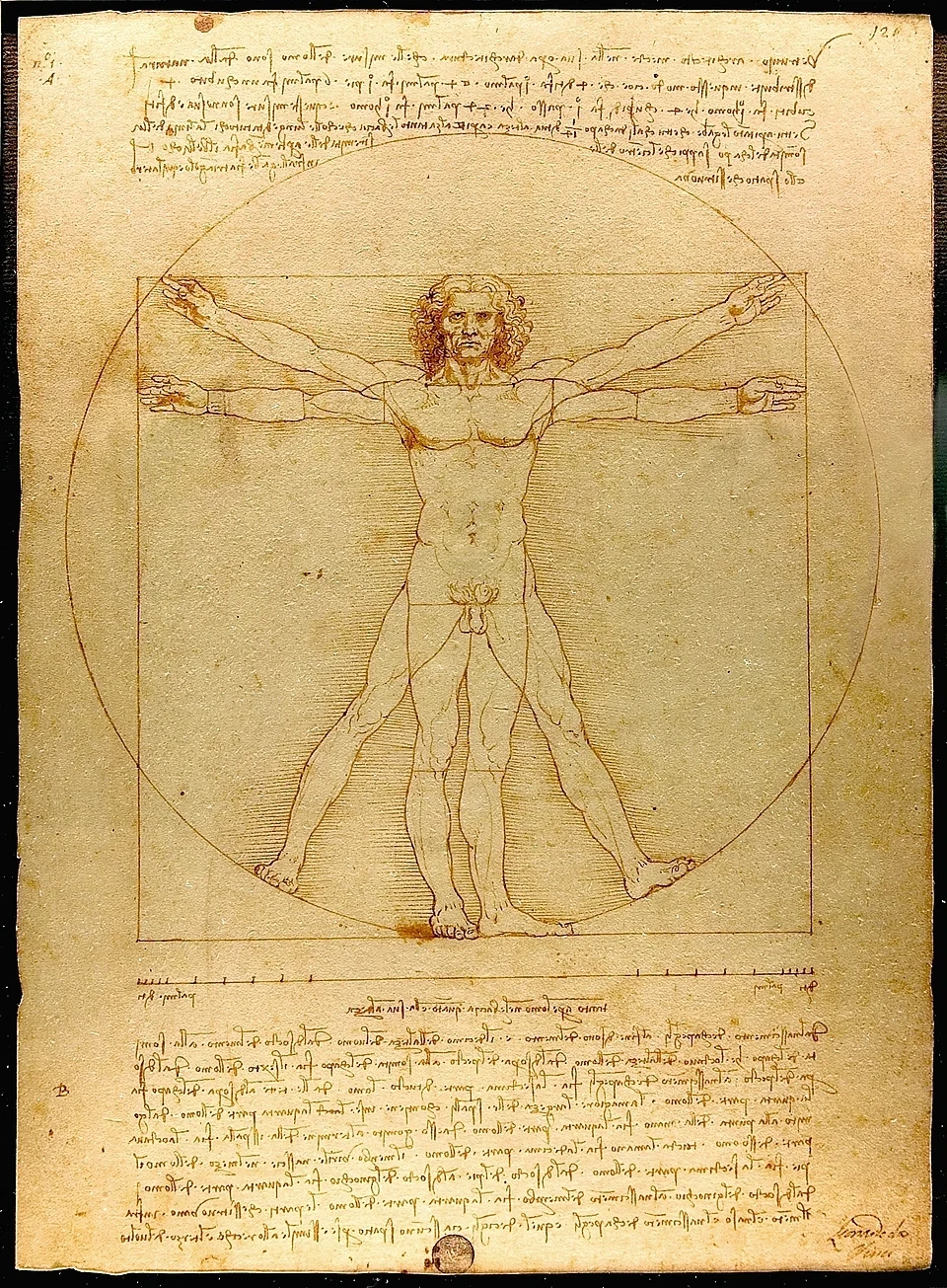
That quality is not new. It did not begin with Fleming or Becquerel. It is there in the notebooks of the artists who first tried to understand the human body not as a symbol but as a fact — who looked carefully at the thing in front of them and refused to paint it until they understood how it worked from the inside. The Vitruvian Man is not a drawing of a body. It is a record of someone paying attention.
The mural on your wall belongs to the same tradition. Someone looked carefully. Someone asked why. The science was already there.
Science & Technology
Read our Science Behind the Art section →2027 — The shift point
When the accident is a war
Halévy's fourteen geniuses all shared one quality: they were prepared for the unexpected. They had done the reading, the thinking, the practice — so that when the moment arrived, they could see it for what it was. The unprepared mind looks at the fogged photographic plate and sees a ruined experiment. The prepared mind looks at the same plate and discovers radioactivity.
We are approaching a moment that will require the same quality — not in a laboratory, but in ordinary life. The geopolitical pressures converging on 2027 are not hidden. They are in the newspapers, in the think-tank reports, in the statements of heads of state. France is locking Europe into a confrontation with Russia before its 2027 elections close the political window. Germany is rearming. The US Congress has restored Ukraine funding. The neoconservative faction is back in control. Kaliningrad is a time bomb. The front line is not stabilising.
The unprepared mind looks at the fogged plate and sees a ruined experiment. The prepared mind discovers radioactivity.
The generation that grew up after 1945 was the first in European history to assume that peace was the default. It was not. It was the exception — the product of specific political arrangements, specific deterrents, specific memories that are now fading. The prepared mind does not assume the experiment will go as planned. It watches for the unexpected result.
The question Withington News is asking — are you prepared for the coming war? — is not a provocation. It is the same question Halévy is asking about science. Not: do you have the right answer? But: are you paying attention? Are you ready to see what is actually in front of you?
Read the full analysis and cast your vote →